Discover the Cornish Language
An online resource for anyone interested in learning Cornish. Explore our phrasebook, vocabulary guides, FAQs, and a comprehensive directory of learning resources — from books and dictionaries to online courses and organisations.
Cornish names for beaches and coastal features
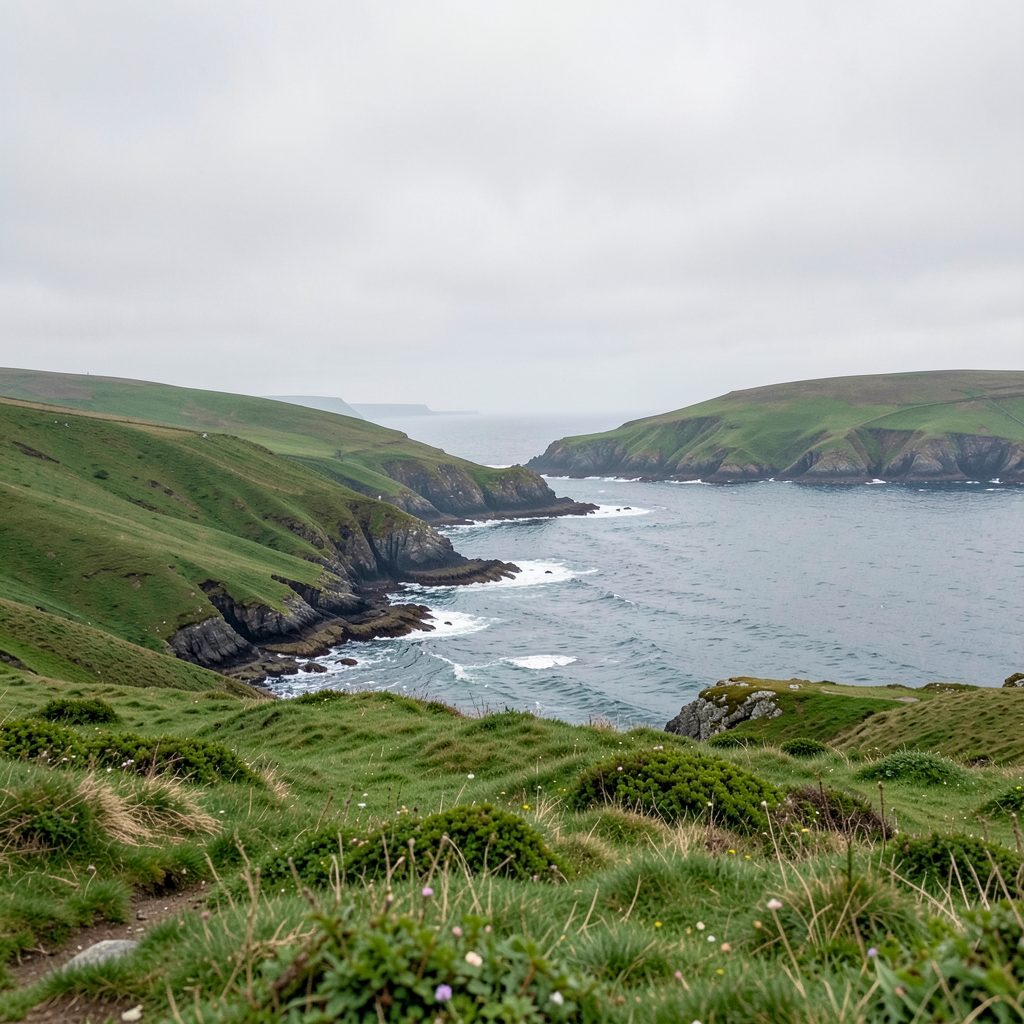
Cornwall's coastline is compact and dramatic, with granite cliffs, coves, beaches and fishing harbours packed into a few hundred miles of Atlantic shore. Long before English was spoken here, the peninsula had a Celtic-speaking population whose words for cove, head and harbour survive in almost every map. Cornish place names are therefore less quaint labels than ordinary Cornish words, and they are the clearest evidence most people will ever meet that Kernewek, the revived Cornish language, works again in the present tense.
That evidence is easy to miss, because many names have been reshaped for English readers. Mousehole, Falmouth, Truro, Penzance and Portreath all hide Cornish words in their sound, while others keep the original element intact: Porthcurno, Boscastle, the Cornish Lanust for St Just, the Pen Kernow of Cape Cornwall. The language lost its place in classrooms and churches after the sixteenth century, and official records preferred English forms for two centuries. Its recognition as a UNESCO minority language in 2010, followed by an agreed Standard Written Form in 2011, has encouraged Cornish speakers to return these names to maps and signposts.
The coastline makes an unusually good classroom, because its vocabulary repeats. A handful of elements — porth, pen, tre, bos, karrik, poll, dowr — combine with local words to describe harbours, headlands, farmsteads, cliffs, pools and rivers. Recognise the elements and an unfamiliar name starts to unpack, and that pattern work is what keeps a revived language usable for learners.
This site collects Cornish vocabulary, phrasebooks and answers for learners at different stages, and its material on place names sits well beside a coastline walk. What follows takes the common elements first, then works along the shore, then compares the habits with Australian beaches and headlands, where Aboriginal names have carried a similar double life. Pronunciation differs between the traditional west Cornish dialects and the revived standard, so glosses are offered with the caution that place-name scholarship has earned.
Why the coast keeps its Cornish words
Cornish names along the shore are not decorative leftovers. They are the speech of people who fished, farmed, mined and sailed from these places, and a fisherman's child in Mousehole or a miner's household in St Agnes once heard Kernewek at the hearth, in the chapel and at market. The names of their coves, quays, hamlets and headlands were the working descriptive words of that speech, which is why they travel so well.
The economy that produced them is why the coast is famous. Pilchard shoales, tin, copper, china clay, shipbuilding and smuggling each left vocabulary of work, and the Cornwall and West Devon Mining Landscape has carried UNESCO World Heritage status since 2003. Chapel sites survive in a set of formulas: lan means a church site, giving Lanust for St Just, Lan Maugan for St Mawgan and Lan Agnis for St Agnes.
Since the revival, place-name research has been treated as part of recovering the language rather than as folklore. Work by the Cornish Language Society and bilingual signage funded through Cornwall Council has settled many spellings, while the Standard Written Form discourages the invention of Cornish-sounding forms for English concepts. For learners, that matters: the spelling taught in a guide is the spelling a sign painter or mapmaker will use.
Porth and the places to land a boat
The commonest element on any Cornish coast is porth, meaning cove, harbour or port. Mousehole is usually given as Porth Chese, the cove of the cheese, referring to the cave used for storing cheese. Portreath becomes Porth Reath, the cove of the sand. Porthtowan near St Agnes is now read by many speakers as the cove of the white one. Porthmeor above St Ives carries meor, great, in the sense of the great sea beyond.
Porthcurno points either to Cornwall itself or to Cornou, a district whose name may relate to a horn, and Porth Ia gives St Ives its Cornish name, the cove of Ia. The word is shared with Welsh, where porth still means port or harbour in Porthmadog, Port Talbot and Porthcawl, and it also sits behind English names such as Port Isaac. English borrowed port from Latin, so the Cornish original is the one that came first.
One element unlocks a dozen names from Land's End to the Lizard, and porth pairs easily with almost any noun found on the shore: a saint, a customs house, a quay, a mill. Falmouth's Porth Vaen, the port of the custom, is the neatest example, with vaen meaning both duty and price.
Pen, tre and bos on the headlands
Pen means head, and headland names use it openly. Cape Cornwall is Pen Kernow, the head of Cornwall, quietly claiming the far west of the peninsula for the language. Land's End is commonly given as Pen Gor, the head of the moor or gorse country, and Pendeen on the Lizard keeps the same pen with an element tied to old woodland. Welsh shows the same logic in penrhyn for a headland.
Tre means settlement, farm or estate, surviving in Tresco, Tregony, Tremaine and in Treveru, the Cornish name for Truro, where try, three, and veru, a ford, describe the meeting of routes. Bos means dwelling, and Boscastle becomes Boskastell, the dwelling of the castle, while Bosherston begins from the same bos.
These are working elements rather than fossil prefixes, which makes them easy to teach and easy to check. A learner who knows pen, tre and bos can read a dozen Cornish names on a map without a dictionary, and the recognition transfers to other Cornish material, including the family names that still fill the diaspora records.
Rock, sand, pools and running water
Karrik means cliff or rock, and it gave English Carrick, a common Cornish prefix for a rocky place. Poll is pool, and the Cornish first elements in Polperro and Polzeath describe the deep enclosed water filling those harbours, which English names beside them simply call a pool or a harbour. Reth is sand, gors is gorse or rough moor, and gwenn is white, the colour in Pennanz, the white head of Penzance.
Water has its own word, dowr, which is why the Tamar is Dowr Tamar and Falmouth's river becomes Dowr Vaen, the water of the custom, alongside Porth Vaen. An Mor, the sea, appears in descriptions of the northern shore, and meor, great, adds the open Atlantic to Porthmeor.
Cornish names also record trade rather than landscape alone. Marazion's Cornish name, Merezhy, is usually explained as a little market, and Morwenstow ends in stow, Cornish for a seat or place of residence, meaning the place of Morwen. Phrasebooks and vocabulary lists on Learn Cornish carry these elements with pronunciation notes, so a name heard on a podcast can be matched to the form written on a board.
Singing the shoreline into memory
Coastal names are sung as well as written. Fishermen's songs, emigration songs and the shanties of the old Cornish ports put harbours and headlands into lines people remember without trying, which is the strongest kind of vocabulary drill available. For a learner working alone, the site's guide to songs for language practice offers a practical route in: follow the Cornish text of a recording and mark the names you already recognise from a map.
Listening teaches what a book cannot. Cornish carries a strong stress pattern, and songs make it plain where the weight falls on gwenn, reth or karrik. A name lands differently in a sung line than on a sign, and hearing it in that context is what shifts recognition into recall.
A living vocabulary in a modern world
Cornish absorbs new vocabulary as readily as it keeps old. Modern coinage stays cautious, following the Standard Written Form, yet speakers will happily coin a phrase when a situation calls for one. The playful end of that habit is served by the site's guide on wild symbol gaming machines, which sets fruit-machine vocabulary in Cornish so learners can talk about wild symbols, jackpots and bonus rounds while chasing a win.
Signage is the other modern surface. Bilingual Cornish and English boards now appear at harbours, coves and village greens, and visitors photograph them, spreading the forms further than any textbook. Apps, online courses and weekend classes put the same accepted spellings into people's hands and onto their keyboards.
Cornish coast names on Australian shores
Australian beaches and headlands draw on a smaller set of English elements: beach, bay, cove, inlet, point, head, cape. Sydney's Bondi Beach is a beach and a bay, Queensland's Hervey Bay and Moreton Bay are bays and inlets, and Western Australia's Cape Tribulation and Cape Leeuwin are capes and points. Australians say "the cove" for a small enclosed water and "muster" for a surf club's safety drill, and they seldom use a Cornish-style port or Kernow element at all.
Aboriginal coastal names in Australia survived by being respelt and pronounced. Bondi carries the Dharug word boondi, associated with the noise of water, and Coogee comes from a Dharug word for the sound of water. Narrabeen, Ben Buckler and Noosa hold their own heritage in the same way, and councils in New South Wales and South Australia increasingly put both names on signs, a bilingual practice Cornish campaigners would recognise at once.
Cornish migrants also reached Australia, and their trail is easier to trace than most. Miners from Cornwall worked the copper and lead mines of South Australia at Burra, Kapunda, Moonta and Wallaroo, and Bendigo in Victoria drew men from the same parishes. That is why the Cornish Association of South Australia keeps ties through Adelaide, and why Cornish culture surfaces at Celtic gatherings such as the festival at Portarlington in New South Wales.
The market for Cornish study material in Australia is small but orderly. Irish and Scottish Gaelic titles dominate the shelves, and Cornish books are usually ordered through online bookshops such as Booktopia, Fishpond or AbeBooks Australia, priced in Australian dollars with GST on the invoice. Print runs travel by post, so a guide ordered today may arrive after winter, while a digital copy is in hand before the coffee.
The practical takeaway is that Cornish coastal names are assembled from a small set of parts, and learning those parts changes how a map reads. Four elements — porth, pen, tre and bos — with karrik, poll and dowr will make sense of most of the shoreline, and each one is a word worth keeping for the conversations that follow. Phrasebooks and place-name guides hold the accepted forms and the pronunciation notes, so vocabulary learned from a song can be checked against the spelling on a sign.
Carried to Australian shores, the same names invite a natural comparison: a Cornish cove beside an Australian one, a Cornish head beside Cape Tribulation, a Cornish pool beside the tidal water of a bay. Keeping the Cornish forms next to the local ones gives learners two handles on the same coastline, and spellings like Porth Chese or Pen Kernow stay alive for as long as somebody still says them.
Stay connected with the Cornish language community.